
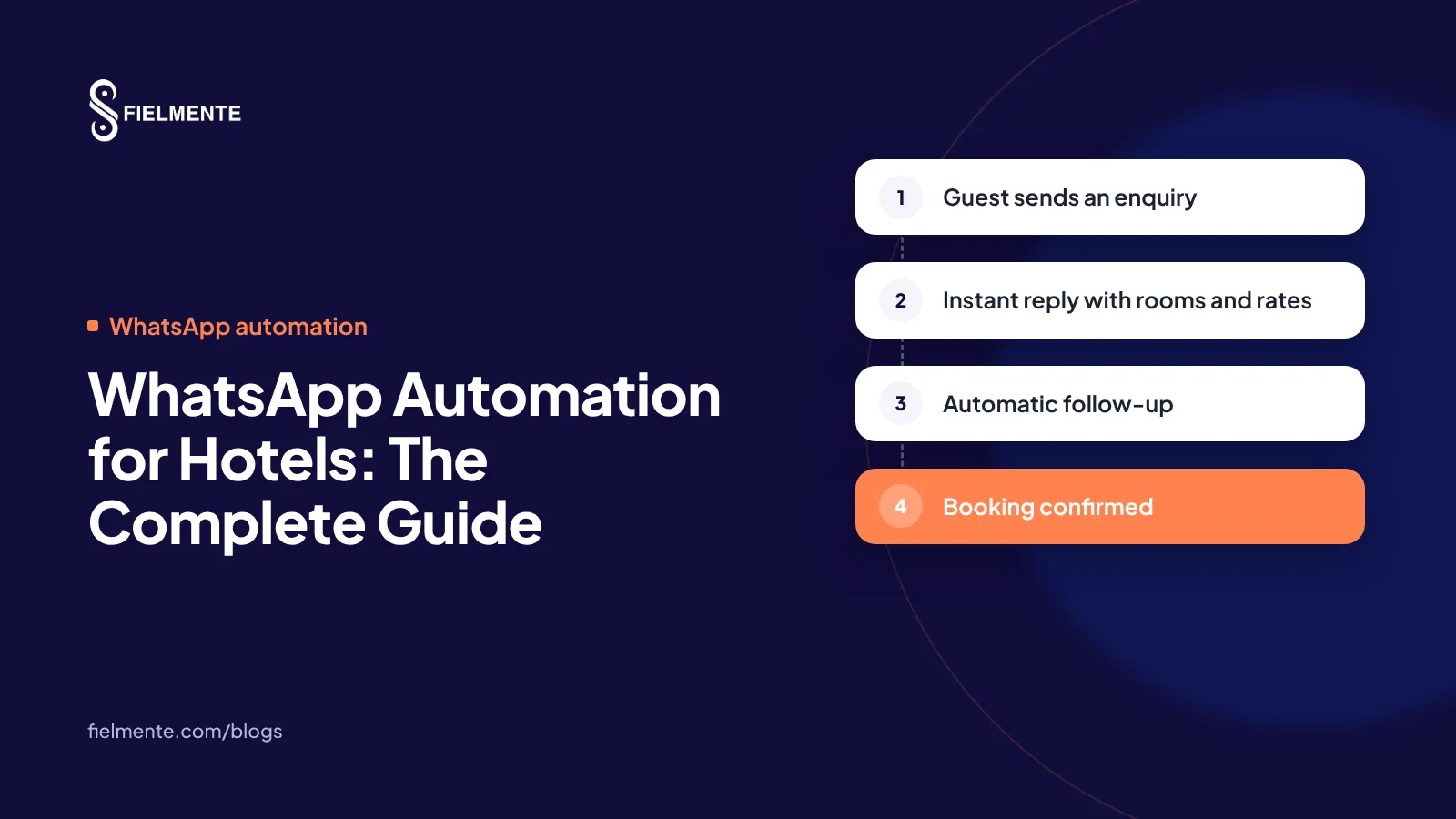
WhatsApp Automation for Hotels: The Complete Guide is a practical topic for hotel owners, general managers, revenue managers and sales teams because WhatsApp is already one of the places where guests ask questions, compare options and decide whether to book. The opportunity is not simply to reply faster. It is to build a repeatable sales and service process around hotel enquiries and direct bookings so that high-intent conversations move forward even when the team is busy or offline.
This guide explains what WhatsApp automation for hotels should do, where automation is useful, which integrations matter, what should stay human, and which metrics show whether the system is actually improving direct-booking performance. The focus is operational: accurate answers, clear ownership, measurable follow-up and a guest experience that still feels like hospitality.
Quick answer
For most hotels, WhatsApp automation for hotels works best as a hybrid sales system: automate instant acknowledgement, qualification, routine questions and structured follow-up, while sending high-value, uncertain or sensitive conversations to a human. The strongest results come when WhatsApp is connected to reliable hotel systems instead of operating as an isolated chatbot.
Core building blocks
- An approved WhatsApp Business Platform setup and business identity.
- A property knowledge base covering rooms, policies, packages, dining, spa, experiences and frequently asked questions.
- Integrations for live availability, pricing, booking, CRM, PMS or payments when the use case requires them.
- Automation rules for qualification, follow-up, escalation, opt-in and message-template use.
- Reporting that connects conversation activity to bookings and revenue.
A practical rollout sequence
- Start with one high-volume, high-friction enquiry type rather than automating everything on day one.
- Measure current response time, conversion and follow-up leakage to create a baseline.
- Build property-specific answers and hand-off rules, then connect the minimum systems needed for accurate answers.
- Pilot with a controlled audience, review transcripts, fix failure cases and expand only after the flow is stable.
What the guest journey should look like
A useful hotel WhatsApp journey is short and purposeful. The guest should always know what happens next.
- Entry point: the guest opens WhatsApp from the hotel website, paid campaign, social profile, QR code, Google Business Profile or a saved contact.
- Intent detection: the system identifies whether the guest wants rooms, packages, dining, spa, an event, a booking change or general information.
- Minimum qualification: collect only the details needed to give a useful answer. For room sales this usually means dates, guests, rooms and preferences.
- Accurate recommendation: use the hotel’s controlled knowledge base and live systems where required. Never invent availability, rates, policies or package inclusions.
- Conversion step: send a booking link, payment path, call-back option, site-visit scheduler or human hand-off depending on intent.
- Follow-up: if the guest does not convert, schedule context-aware follow-up and stop once the lead books, declines or opts out.
Metrics that should be tracked
Do not judge WhatsApp automation by message count alone. Track metrics that connect operations to commercial outcomes:
- Median first-response time and percentage of enquiries answered within the target SLA.
- Qualified-lead rate and percentage of conversations that reach a clear next step.
- Enquiry-to-booking conversion rate for WhatsApp-assisted leads.
- Direct-booking value and gross revenue influenced by WhatsApp.
- Follow-up completion rate and recovered-lead revenue.
- Human hand-off rate, hand-off response time and reasons for escalation.
- Sales-team time saved on repetitive questions.
- Upsell or ancillary revenue where relevant.
Common mistakes to avoid
- Automating inaccurate information. Fast wrong answers are worse than slower verified answers.
- Trying to automate every conversation. High-value or complex leads often need a person.
- No ownership after hand-off. If automation sends a lead to sales, the system should record who owns it and by when.
- Sending generic follow-ups. A follow-up should reflect the original enquiry, dates and objection.
- Ignoring consent and platform rules. Promotional and template messaging should follow the current WhatsApp Business Platform requirements.
- No measurement baseline. Record current response time, lead volume and conversion before rollout so improvement can be proved.
WhatsApp automation for resorts
Resort enquiries are longer and more seasonal than city-hotel enquiries. Guests ask about packages, meal plans, activities, transfers and child policies, often for two or three nights over a weekend or festival. Set up automated answers for these recurring questions, and send package details and photos in the first reply.
Keep a person in the loop for group bookings, long stays and anything involving custom itineraries. During peak months, use follow-up sequences so guests who asked about dates but didn't book hear back within a day.
For boutique hotels
Boutique hotels sell character, so automated replies should sound like the property, not a call centre. Write replies in your own voice, mention the details that make the hotel different, and hand conversations to the owner or front office quickly when a guest wants to talk.
Small teams gain the most from automating instant acknowledgement, rate and availability questions and next-day follow-ups. These are the messages that otherwise wait until someone is free.
For luxury resorts
Luxury guests expect concierge-style service, so automation should be invisible. Use it to answer instantly, share villa and experience details, and capture preferences such as dates, occasion and dietary needs. Then pass the conversation to a named guest relations executive with full context.
Avoid pushy follow-ups. One thoughtful message with a relevant suggestion, such as a spa ritual or private dining, works better than repeated reminders.
For homestays and small properties
Homestays are often run by one or two people, and most enquiries arrive on WhatsApp in the evening. A simple setup goes a long way: an instant welcome message, answers to the five questions guests always ask (price, meals, parking, pets, directions), and a payment link for confirmed dates.
Start with the WhatsApp Business app and quick replies. Move to the WhatsApp Business Platform when the volume of messages becomes hard to manage by hand.
For villas and vacation rentals
Villa enquiries centre on group size, minimum stay, house rules, staff and security deposits. Automate the answers to these, share a photo tour and the floor plan in the first reply, and ask for dates and the number of guests early so quotes are accurate.
Owners with several villas should route each enquiry to the right property and keep one record of the conversation, so repeat guests are recognised next time.
Frequently asked questions
What is WhatsApp automation for hotels?
WhatsApp automation for hotels is the use of WhatsApp workflows, automation and—where appropriate—AI to handle parts of hotel enquiries and direct bookings. The goal is not to remove hospitality from the conversation, but to make response speed, consistency and follow-up more reliable.
Can hotels automate WhatsApp without sounding robotic?
Yes. The best setup uses property-specific information, short natural replies, clear hand-off rules and human escalation for complex, emotional or high-value conversations.
What should a hotel connect to WhatsApp automation?
A practical stack may connect the hotel website, booking engine, CRM, PMS, payment flow and approved WhatsApp Business Platform setup. The exact integrations depend on the use case and the property’s systems.
How should hotels measure ROI from WhatsApp automation?
Track response time, qualified-lead rate, booking conversion, follow-up completion, direct-booking share, sales-team workload, ancillary revenue and cost per confirmed booking. Compare these with a pre-automation baseline.
Final takeaway
WhatsApp automation for hotels should make the hotel easier to buy from, not merely easier to message. Start with one measurable bottleneck, connect the systems needed for accurate answers, define human escalation clearly and track the path from enquiry to revenue.
Work with Fielmente
Want to design a hotel WhatsApp sales journey that connects marketing, automation and direct booking? Talk to Fielmente about a hospitality-specific implementation plan and the integrations your property actually needs.
Not sure which platform fits your property? Get a free 15-minute website audit from our team.