
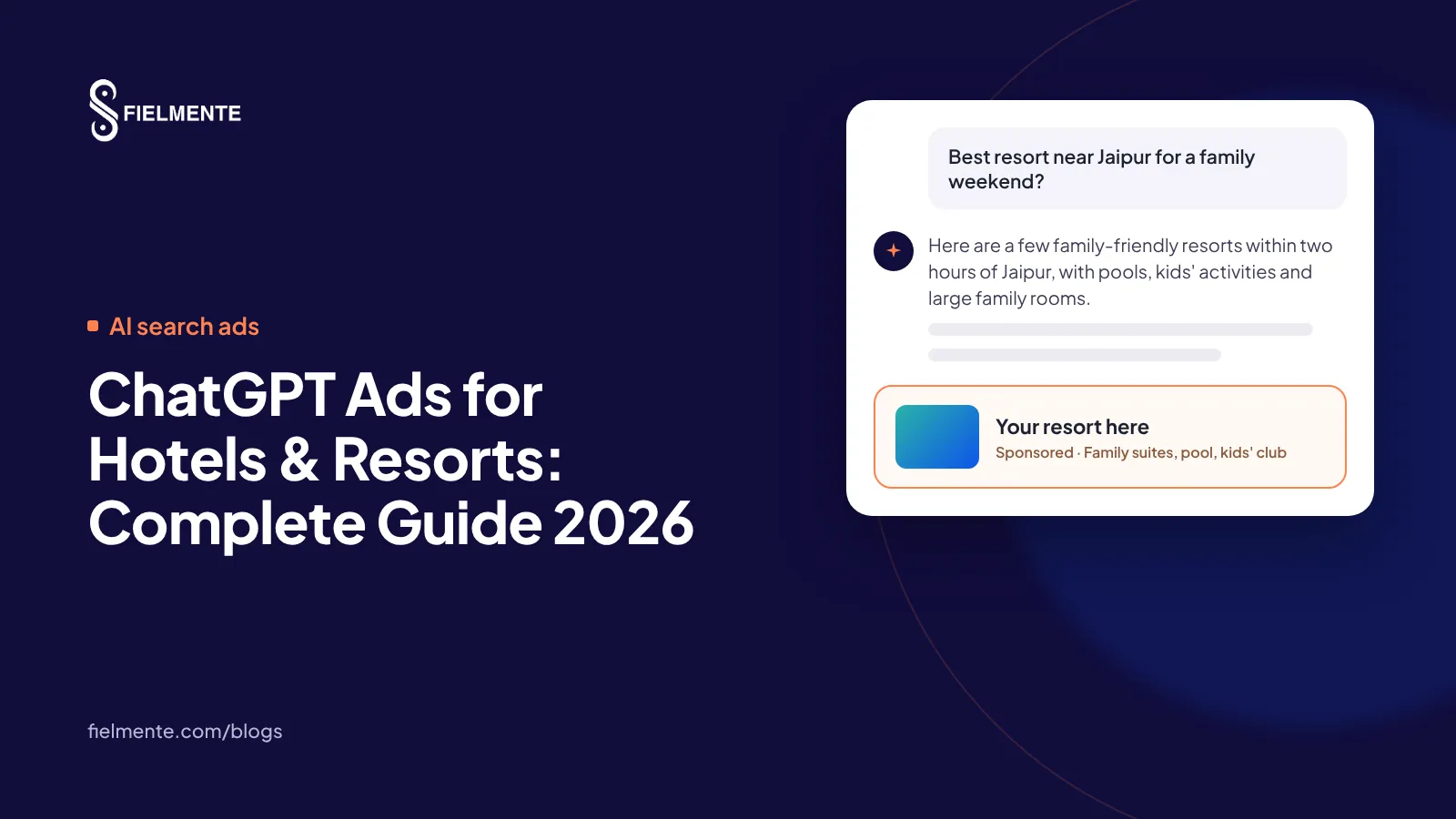
Travellers no longer rely only on Google, online travel agencies (OTAs) and social media to plan a holiday. They are increasingly using AI assistants to research destinations, compare properties, plan itineraries and decide where to stay.
Questions such as these are becoming part of the modern booking journey:
- “Which is the best family resort near Jaipur?”
- “Where should I stay in Goa for a destination wedding?”
- “Suggest a wellness resort for a three-night break.”
- “Which hotels near the airport offer meeting facilities?”
- “Help me plan a romantic weekend within driving distance of Delhi.”
This shift has created a new advertising opportunity for hospitality businesses: ChatGPT Ads.
Unlike a conventional search ad triggered mainly by a short keyword, a ChatGPT ad can be matched to the broader context and intent of a user’s conversation. For hotels and resorts, this creates an opportunity to appear while a potential guest is actively exploring, comparing or making a travel decision.
What are ChatGPT Ads?
ChatGPT Ads are sponsored placements that may appear below a ChatGPT response. According to OpenAI, an ad can include the advertiser’s name and favicon, a title, descriptive copy, a landing page and an image.
Ads are clearly labelled and kept separate from ChatGPT’s organic answer. Advertisers cannot pay to change, influence or rank within the answer itself. OpenAI also states that advertisers do not receive access to users’ private conversations.
The advertising system considers signals such as the context and intent of the current conversation, the ad’s landing page, title, copy, advertiser-provided context hints and eligible personalisation signals. Context hints are not exact-match keywords; they help the system understand the situations in which an offering may be useful.
As of September 2026, self-service OpenAI Ads Manager access is available in India as well as several other markets. Advertisers should still verify current availability and features before launching, as the platform remains in beta and is evolving.
Why ChatGPT Ads matter for hotels and resorts
Hotel marketing often becomes a contest for attention. On search engines, a property competes against OTAs, aggregators and nearby hotels for the same keywords. On social platforms, it tries to interrupt users while they are scrolling.
ChatGPT Ads enter the journey at a different moment: when a person is explaining what they need.
A traveller may share the destination, number of guests, budget, occasion, preferred facilities and travel dates within a single conversation. That richer context can help a relevant property present a useful offer at the consideration stage.
This can be valuable for:
- Boutique hotels seeking more direct bookings
- Resorts promoting weekend packages or seasonal experiences
- Wedding resorts targeting destination-wedding enquiries
- Wellness retreats promoting specialised programmes
- Business hotels marketing conferences and corporate stays
- Properties advertising restaurants, events, day outings or pool packages
- Hotel groups building awareness in new source markets
ChatGPT Ads should not replace Google Ads, Meta Ads, SEO or OTA visibility. They should be tested as an additional high-intent discovery channel within a wider hotel performance-marketing strategy.
How ChatGPT Ads differ from Google and Meta Ads
| Channel | Primary signal | Typical strength for hotels |
|---|---|---|
| Google Ads | Search keywords and commercial intent | Capturing guests already searching for a hotel, resort or destination |
| Meta Ads | Audience, interests, behaviour and creative engagement | Creating demand through strong visual storytelling and offers |
| ChatGPT Ads | Conversational context, intent, ad content and context hints | Reaching travellers while they research, compare and plan |
The practical difference is important. A Google user may type “resort in Goa,” while a ChatGPT user may describe a multi-part requirement: a beachfront resort for 50 wedding guests, with event spaces, vegetarian catering and airport transfers.
For the advertiser, this means generic copy is unlikely to be enough. The ad, context hints and landing page should clearly explain who the property is for, what problem it solves and when it is most useful.
The best ChatGPT Ads campaign structure for a hotel
A hotel should avoid placing every service in one broad ad group. OpenAI recommends keeping ad groups focused on one theme, product category or intent area and using separate groups for meaningfully different use cases.
A practical hotel campaign could include the following ad groups:
1. Direct room bookings
Use this group for travellers comparing accommodation, room types, amenities and direct-booking benefits.
Possible context: Couples or families looking for a hotel in the property’s destination, comparing room options, checking amenities or seeking direct-booking offers.
2. Weekend and holiday packages
Focus on short breaks, seasonal packages and drive-to travellers.
Possible context: People planning a two- or three-night getaway, a family holiday, a monsoon break or a festive vacation from nearby cities.
3. Weddings and celebrations
Create a separate journey for weddings, anniversaries, birthdays and private events.
Possible context: Couples or planners comparing destination-wedding venues, guest accommodation, banquet capacity, catering and event packages.
4. Corporate events and group stays
Promote meeting facilities, off-sites, conferences and group accommodation.
Possible context: Companies planning a team off-site, conference, training programme or corporate retreat with rooms and meeting spaces.
5. Wellness or experience-led stays
Use this for properties with a strong spa, yoga, Ayurveda, nature, adventure or culinary proposition.
Possible context: Travellers seeking a wellness break, detox programme, spa holiday, nature retreat or activity-based stay.
Each ad group should contain multiple genuinely different ad variations. One variation could lead with location, another with the guest experience, another with a package and another with a direct-booking benefit.
Choosing the right campaign objective
OpenAI Ads Manager currently supports three campaign objectives:
- CPM: Designed for reach and awareness; the advertiser pays per 1,000 impressions.
- CPC: Designed to generate website visits; the advertiser pays per valid click.
- oCPC: A conversion-optimised cost-per-click objective that seeks clicks more likely to result in a selected conversion. The advertiser still pays per valid click, not per conversion.
For most independent hotels beginning with ChatGPT Ads, a CPC campaign is a sensible starting point because it creates a clear bridge between ad spend and qualified visits. Once conversion tracking is reliable and the account has sufficient data, the hotel can test oCPC for booking enquiries or completed reservations.
Awareness-led resorts, new openings and hotel groups entering a market may also test CPM campaigns.
OpenAI currently lists a minimum daily campaign budget of ₹725 for India. This is a minimum, not a recommended budget or a guarantee of performance. Hotels should start with a controlled test, track the full enquiry-to-booking journey and scale only the themes producing qualified demand.
What makes a strong hotel ad on ChatGPT?
OpenAI recommends clear, specific and benefit-focused advertising rather than vague slogans. For hospitality brands, every ad should quickly answer four questions:
- What is the property or offer?
- Where is it located?
- Who or what occasion is it suitable for?
- Why should the traveller click now?
Example: leisure resort
Title: Plan a Relaxing Weekend at [Resort Name]
Copy: Explore comfortable stays, family experiences and direct-booking packages at our resort near [Destination]. Check availability and plan your escape.
Example: destination wedding
Title: Host Your Destination Wedding Near [City]
Copy: Discover guest rooms, celebration spaces and customised wedding packages at [Resort Name]. Request venue details and availability.
Example: wellness retreat
Title: Personalised Wellness Stays in [Destination]
Copy: Combine comfortable accommodation with yoga, spa and guided wellness experiences. Explore programmes and enquire directly.
The image should be simple, relevant and consistent with the message. If the ad promotes a wedding venue, show the venue or a real celebration setup—not an unrelated room photograph. If it promotes wellness, use authentic imagery of the retreat, treatment environment or guest experience.
Your landing page can decide campaign performance
Sending every ad to the hotel homepage is a common mistake. A traveller clicking a wedding ad should land on a wedding page. A user researching a wellness programme should see the programme, inclusions, duration and enquiry path immediately.
A strong hotel landing page should include:
- A clear headline matching the ad’s promise
- Location and accessibility information
- Relevant rooms, venues, amenities or programme details
- Authentic photographs and short videos
- Package inclusions or a transparent starting price, where appropriate
- Guest reviews and trust signals
- A fast enquiry form
- Click-to-call and WhatsApp options
- A visible booking-engine link for room campaigns
- Frequently asked questions
- Fast mobile loading and accurate conversion tracking
The destination URL should include UTM parameters so ChatGPT Ads traffic can be separated in analytics. OpenAI also requires landing pages to be valid, reachable and accessible to its relevant web crawlers.
Connect ChatGPT Ads with AI and CRM automation
An ad click is only the beginning. Hospitality leads often go cold because the property replies late, asks the same questions repeatedly or fails to follow up.
A connected hotel funnel can work like this:
- A traveller discovers the hotel through a relevant ChatGPT ad.
- The traveller opens a dedicated landing page.
- A website chatbot or WhatsApp AI agent answers questions instantly.
- The system collects dates, guest count, room requirements, occasion and budget.
- The lead enters the hotel CRM with its campaign source.
- The reservation or sales team receives a qualified lead and follow-up task.
- Automated messages share the brochure, quotation or booking link.
- Revenue is attributed back to the campaign when the booking is confirmed.
This is where hotels can gain more than traffic. By connecting advertising with AI chat, WhatsApp automation, voice agents and CRM follow-up, the property can improve response speed and create a more measurable direct-booking process.
What should hotels measure?
OpenAI Ads Manager reporting includes impressions, clicks, spend, click-through rate, average CPC, average CPM and conversions. Hotels should combine these platform metrics with their own CRM and booking data.
The most useful hospitality KPIs include:
- Cost per qualified enquiry
- Enquiry-to-booking conversion rate
- Cost per confirmed booking
- Direct-booking revenue
- Return on ad spend
- Average booking value
- Cancellation rate
- Response time
- Lead quality by ad group
- Assisted bookings generated through WhatsApp, phone or the booking engine
Clicks alone do not tell a hotel whether a campaign is profitable. A campaign generating fewer but better wedding enquiries may be more valuable than one producing a large number of low-intent room clicks.
Common mistakes to avoid
- Combining rooms, weddings, restaurants and corporate events in one ad group
- Using broad phrases such as “best luxury experience” without evidence or detail
- Sending all traffic to a generic homepage
- Using the same title, copy and image in every variation
- Launching without conversion tracking and UTM parameters
- Measuring form submissions without checking booking quality
- Making offers that are not clearly available on the landing page
- Failing to respond immediately after an enquiry
- Scaling spend before enough booking and revenue data is available
Are ChatGPT Ads worth testing for your hotel?
Yes—provided the campaign is treated as a measured experiment, not a shortcut to guaranteed bookings.
ChatGPT Ads give hotels and resorts a chance to participate in a new type of travel discovery: one built around natural-language needs rather than only search keywords or social interests. Properties with distinct experiences, strong landing pages and fast enquiry handling are well placed to test the channel.
The winning approach will connect four elements: accurate conversational positioning, useful creative, a focused landing page and a reliable conversion system.
Build your hotel’s AI-powered direct-booking funnel with Eazotel
Eazotel helps hotels and resorts bring their digital growth activities into one connected strategy. Our solutions include ChatGPT Ads and performance marketing, hotel websites and landing pages, AI-powered website chatbots, WhatsApp automation, voice agents, CRM workflows, social media marketing and OTA management.
Whether your goal is to generate room bookings, wedding enquiries, group business or wellness leads, we can help you build the campaign, automate guest conversations and track enquiries through to conversion.
Ready to explore ChatGPT Ads for your hotel or resort? Visit www.eazotel.com to connect with our team.
Frequently Asked Questions
Can hotels in India advertise on ChatGPT?
Yes. OpenAI’s current Ads Manager availability page lists India as available for self-service access. Availability and product features can change, so advertisers should confirm the latest status in Ads Manager.
Where do ChatGPT Ads appear?
OpenAI states that ads can appear below ChatGPT responses. They are labelled as sponsored and visually separated from the answer.
Do advertisers see a traveller’s ChatGPT conversation?
No. OpenAI states that advertisers do not receive access to private chats, chat history, memories or personal details. Advertisers receive aggregated campaign-performance information.
How much should a hotel spend on ChatGPT Ads?
OpenAI currently lists ₹725 as the minimum daily campaign budget in India. The right testing budget depends on the hotel’s objective, average booking value, market, season and conversion rate. Start with a controlled campaign and scale based on qualified enquiries and confirmed revenue.
Should a hotel use ChatGPT Ads instead of Google Ads?
No. The channels serve different discovery behaviours. Google Ads remains valuable for explicit searches, Meta Ads for visual demand generation and ChatGPT Ads for conversational research and decision-making. A balanced strategy can use all three, with separate measurement for each.
Can ChatGPT Ads generate direct bookings?
They can send potential guests to a hotel’s website, offer page, enquiry page or booking journey. Actual booking performance will depend on the offer, relevance, landing-page experience, pricing, availability and follow-up process.
Official references:
- Ads in ChatGPT: The Basics
- Create Campaigns for ChatGPT Ads
- Create Ad Groups for ChatGPT Ads
- Create Ads for ChatGPT Ads
- Ads Manager Availability
Not sure which platform fits your property? Get a free 15-minute website audit from our team.