
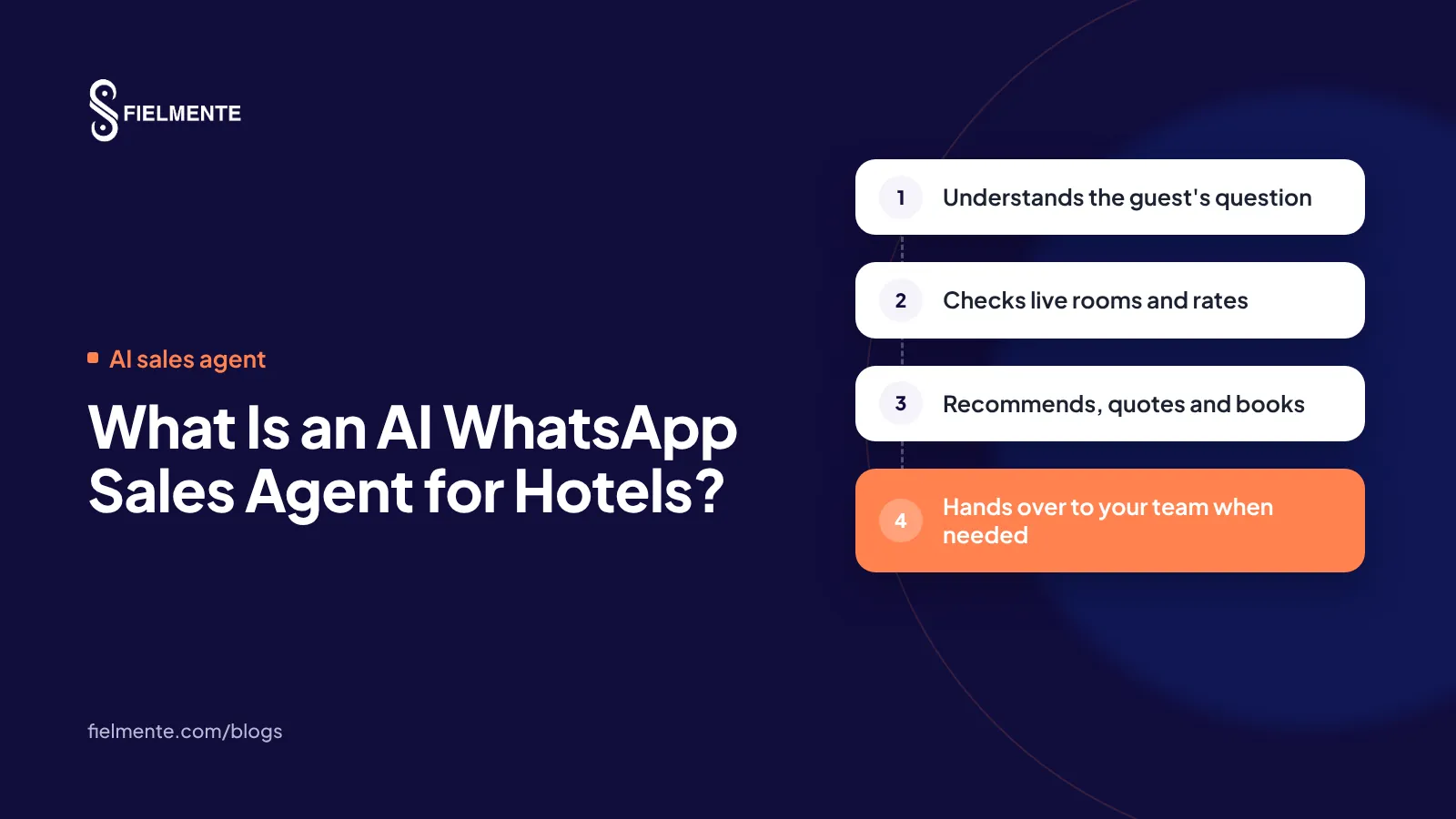
An AI WhatsApp Sales Agent for Hotels is a practical solution for hotel owners, general managers, revenue managers and sales teams because WhatsApp is already one of the places where guests ask questions, compare options and decide whether to book. The opportunity is not simply to reply faster. It is to build a repeatable sales and service process around hotel enquiries and direct bookings so that high-intent conversations move forward even when the team is busy or offline.
This guide explains what an AI WhatsApp sales agent should do, where automation is useful, which integrations matter, what should stay human, and which metrics show whether the system is actually improving direct-booking performance. The focus is operational: accurate answers, clear ownership, measurable follow-up and a guest experience that still feels like hospitality.
Quick answer
For most hotels, an AI WhatsApp sales agent works best as a hybrid sales system: automate instant acknowledgement, qualification, routine questions and structured follow-up, while sending high-value, uncertain or sensitive conversations to a human. The strongest results come when WhatsApp is connected to reliable hotel systems instead of operating as an isolated chatbot.
What is an AI WhatsApp sales agent?
An AI WhatsApp sales agent is a conversational system that communicates with potential hotel guests through WhatsApp and helps move enquiries toward a booking. Unlike a simple FAQ chatbot, a sales agent is designed around the complete lead journey.
It can understand a guest's intent, collect booking requirements, answer approved questions, qualify the lead, recommend the appropriate next step, share booking information and trigger follow-up when a guest does not immediately convert.
The agent should not replace the hotel's sales team. Instead, it handles repetitive and time-sensitive parts of the journey while allowing hotel staff to focus on conversations that require judgement, negotiation or personal attention.
Where automation creates the most value
- First response when a guest enquires outside office hours or during peak periods.
- Lead qualification so the sales team knows dates, guests, purpose of stay, budget range and preferences before taking over.
- Repeatable answers about rooms, inclusions, policies, packages, dining, spa and local experiences.
- Follow-up for undecided leads, abandoned bookings and time-sensitive offers.
- Routing to a human when the question is complex, commercially sensitive or emotionally important.
How an AI WhatsApp sales agent works
A typical hotel implementation can follow a simple sequence from enquiry to booking.
- Guest starts a conversation: The guest contacts the hotel through WhatsApp from the website, advertisement, social profile, QR code, Google Business Profile or saved hotel number.
- Intent detection: The AI identifies whether the guest is asking about rooms, packages, dining, spa, events, reservations or another service.
- Lead qualification: The system collects only the information required to progress the enquiry, such as dates, number of guests, number of rooms and preferences.
- Knowledge retrieval: The AI uses the hotel's approved knowledge base to answer questions about rooms, facilities, policies, packages and experiences.
- Availability or booking action: If connected to appropriate live systems, the workflow can retrieve relevant information or direct the guest to the booking engine.
- Conversion: The guest receives a booking link, payment path, call-back option or human hand-off depending on the situation.
- Follow-up: If the guest does not convert, the system can schedule relevant follow-up until the lead books, declines or opts out.
A hotel-friendly workflow
- A guest starts a WhatsApp conversation from the website, ad, Google Business Profile, QR code or saved hotel number.
- Automation identifies intent and captures essential booking details.
- If live systems are connected, it can retrieve relevant availability or package information; otherwise it asks a human to verify.
- The guest receives a clear next step such as a booking link, payment step, site visit, call or hand-off to sales.
- The CRM or lead log records the conversation and schedules follow-up until the lead is closed or opted out.
What the guest journey should look like
A useful hotel WhatsApp journey is short and purposeful. The guest should always know what happens next.
- Entry point: The guest opens WhatsApp from the hotel website, paid campaign, social profile, QR code, Google Business Profile or a saved contact.
- Intent detection: The system identifies whether the guest wants rooms, packages, dining, spa, an event, a booking change or general information.
- Minimum qualification: Collect only the details needed to give a useful answer. For room sales this usually means dates, guests, rooms and preferences.
- Accurate recommendation: Use the hotel's controlled knowledge base and live systems where required. Never invent availability, rates, policies or package inclusions.
- Conversion step: Send a booking link, payment path, call-back option, site-visit scheduler or human hand-off depending on intent.
- Follow-up: If the guest does not convert, schedule context-aware follow-up and stop once the lead books, declines or opts out.
What an AI sales agent should automate
The best automation focuses on repetitive actions that do not require human judgement.
- Greeting and immediate acknowledgement.
- Basic room and property information.
- Frequently asked questions.
- Collection of booking requirements.
- Lead qualification.
- Booking-link distribution.
- Brochure and package information.
- Reminder and follow-up workflows.
- Lead tagging and CRM updates.
- Routing conversations to the appropriate hotel department.
What should remain human?
AI should not try to handle every hotel conversation independently. Human involvement is especially valuable when the enquiry involves high-value bookings, complaints, negotiations, unusual requests or situations where the guest needs reassurance.
- VIP or high-value reservations.
- Wedding and event enquiries.
- Large group bookings.
- Special pricing or negotiation requests.
- Complaints and service recovery.
- Complex cancellation or refund situations.
- Requests outside the AI's verified knowledge base.
A good hand-off should preserve the conversation context so the guest does not need to repeat the same information to the sales team.
Important hotel integrations
WhatsApp AI becomes more useful when it is connected to the systems already used by the hotel. The exact architecture depends on the property's technology stack.
- Website: Capture visitors and move high-intent users into WhatsApp.
- Booking engine: Provide a direct path from conversation to reservation.
- CRM: Store lead information, conversation status and follow-up activity.
- PMS: Provide relevant guest or reservation information where the integration supports it.
- Payment system: Provide an approved payment path when the guest is ready to book.
- Knowledge base: Give the AI controlled information about rooms, policies, packages, facilities and experiences.
- Analytics: Measure the journey from WhatsApp enquiry to confirmed booking and revenue.
Metrics that should be tracked
Do not judge an AI WhatsApp sales agent by message count alone. Track metrics that connect operations to commercial outcomes:
- Median first-response time and percentage of enquiries answered within the target SLA.
- Qualified-lead rate and percentage of conversations that reach a clear next step.
- Enquiry-to-booking conversion rate for WhatsApp-assisted leads.
- Direct-booking value and gross revenue influenced by WhatsApp.
- Follow-up completion rate and recovered-lead revenue.
- Human hand-off rate, hand-off response time and reasons for escalation.
- Sales-team time saved on repetitive questions.
- Upsell or ancillary revenue where relevant.
- Cost per confirmed booking.
Common mistakes to avoid
- Automating inaccurate information. Fast wrong answers are worse than slower verified answers.
- Trying to automate every conversation. High-value or complex leads often need a person.
- No ownership after hand-off. If automation sends a lead to sales, the system should record who owns it and by when.
- Sending generic follow-ups. A follow-up should reflect the original enquiry, dates and objection.
- Using outdated hotel information. Rates, policies, packages and facilities can change, so the AI should rely on current approved information.
- Ignoring consent and platform rules. Promotional and template messaging should follow the current WhatsApp Business Platform requirements.
- No measurement baseline. Record current response time, lead volume and conversion before rollout so improvement can be proved.
Frequently asked questions
What is an AI WhatsApp sales agent for hotels?
An AI WhatsApp sales agent for hotels is a conversational system that uses WhatsApp workflows, automation and AI to handle parts of hotel enquiries and direct-booking conversations. It can qualify leads, answer routine questions, provide relevant next steps and transfer complex conversations to hotel staff.
Can hotels automate WhatsApp without sounding robotic?
Yes. The best setup uses property-specific information, short natural replies, clear hand-off rules and human escalation for complex, emotional or high-value conversations.
What should a hotel connect to an AI WhatsApp sales agent?
A practical stack may connect the hotel website, booking engine, CRM, PMS, payment flow, knowledge base and approved WhatsApp Business Platform setup. The exact integrations depend on the use case and the property's systems.
Can an AI WhatsApp sales agent increase hotel direct bookings?
It can support higher direct-booking performance by reducing response delays, qualifying leads, answering routine questions and creating structured follow-up. The actual impact should be measured against a pre-automation baseline.
How should hotels measure ROI?
Track response time, qualified-lead rate, booking conversion, follow-up completion, direct-booking revenue, sales-team workload, ancillary revenue and cost per confirmed booking. Compare these metrics with a pre-automation baseline.
Final takeaway
An AI WhatsApp sales agent should make the hotel easier to buy from, not merely easier to message. Start with one measurable bottleneck, connect the systems needed for accurate answers, define human escalation clearly and track the path from enquiry to revenue.
Work with Fielmente
Want to design a hotel WhatsApp sales journey that connects marketing, AI automation and direct booking? Talk to Fielmente about a hospitality-specific implementation plan and the integrations your property actually needs.
Not sure which platform fits your property? Get a free 15-minute website audit from our team.