
Resorts spend heavily on websites, search, social media and digital campaigns to attract potential guests. But getting a visitor to a website is only the first step. Many visitors browse room pages, packages, wedding offerings or special deals without completing a booking or filling out a traditional enquiry form.
WhatsApp can help resorts capture these high-intent visitors before they leave. Instead of forcing every visitor to complete a long form, resorts can provide a simple WhatsApp conversation at the right moment. With the right automation, that conversation can qualify the guest, answer common questions, recommend relevant options and move the enquiry toward a booking or human sales conversation.
This guide explains how resorts can turn website visitors into qualified WhatsApp leads, where automation adds value, which integrations matter, and where human sales teams should take over.
Quick answer
Resorts can convert website visitors into WhatsApp leads by placing contextual WhatsApp calls-to-action on high-intent website pages such as rooms, packages, weddings, events and booking pages. When a visitor starts a conversation, automation can capture basic requirements, answer routine questions and route qualified enquiries to the right sales team.
The best approach is a hybrid system: automation handles repetitive tasks and first-level qualification, while humans handle complex requirements, negotiation, high-value bookings and sensitive conversations.
Why website visitors become lost leads
A visitor may be interested in a resort but still leave without submitting a form or making a booking. They may have questions about room availability, pricing, meals, check-in policies, packages, activities, weddings or group bookings.
Traditional contact forms create friction because the visitor has to enter several fields before starting a conversation. WhatsApp provides a more immediate alternative, especially when the visitor is already using their phone.
- The visitor cannot find an answer quickly.
- The booking process feels complicated.
- The visitor wants to compare packages before booking.
- The visitor has a special requirement.
- The visitor is interested in a wedding or group event.
- The visitor wants to speak with someone before making a payment.
Where resorts should place WhatsApp CTAs
A WhatsApp button should not be treated as a generic contact button placed randomly across the website. Its position and message should match the visitor's intent.
Room pages
On room pages, the WhatsApp CTA can help visitors ask about availability, occupancy, inclusions and room suitability.
Example CTA: Ask About This Room on WhatsApp
Package pages
Resort packages often have different inclusions, dates and conditions. A contextual WhatsApp CTA allows visitors to ask questions before booking.
Example CTA: Check Package Details on WhatsApp
Wedding and event pages
Wedding and event enquiries can have significantly different requirements from normal room bookings. WhatsApp can capture event date, guest count, venue preference and expected requirements before sending the lead to an event sales representative.
Example CTA: Plan Your Event on WhatsApp
Booking pages
Visitors who hesitate during the booking process may need help before completing the reservation. A WhatsApp option can give them a direct path to assistance.
Use contextual WhatsApp messages
One of the biggest advantages of website-to-WhatsApp integration is that the conversation can start with context.
Instead of asking: "How can we help you?"
The system can start with: "Hi, I'm interested in your Deluxe Pool View Room. Can you help me check availability?"
For a wedding page, the message could be: "Hi, I'm planning a wedding and would like to know about your wedding packages and availability."
This reduces friction because the sales team immediately understands what the visitor is interested in.
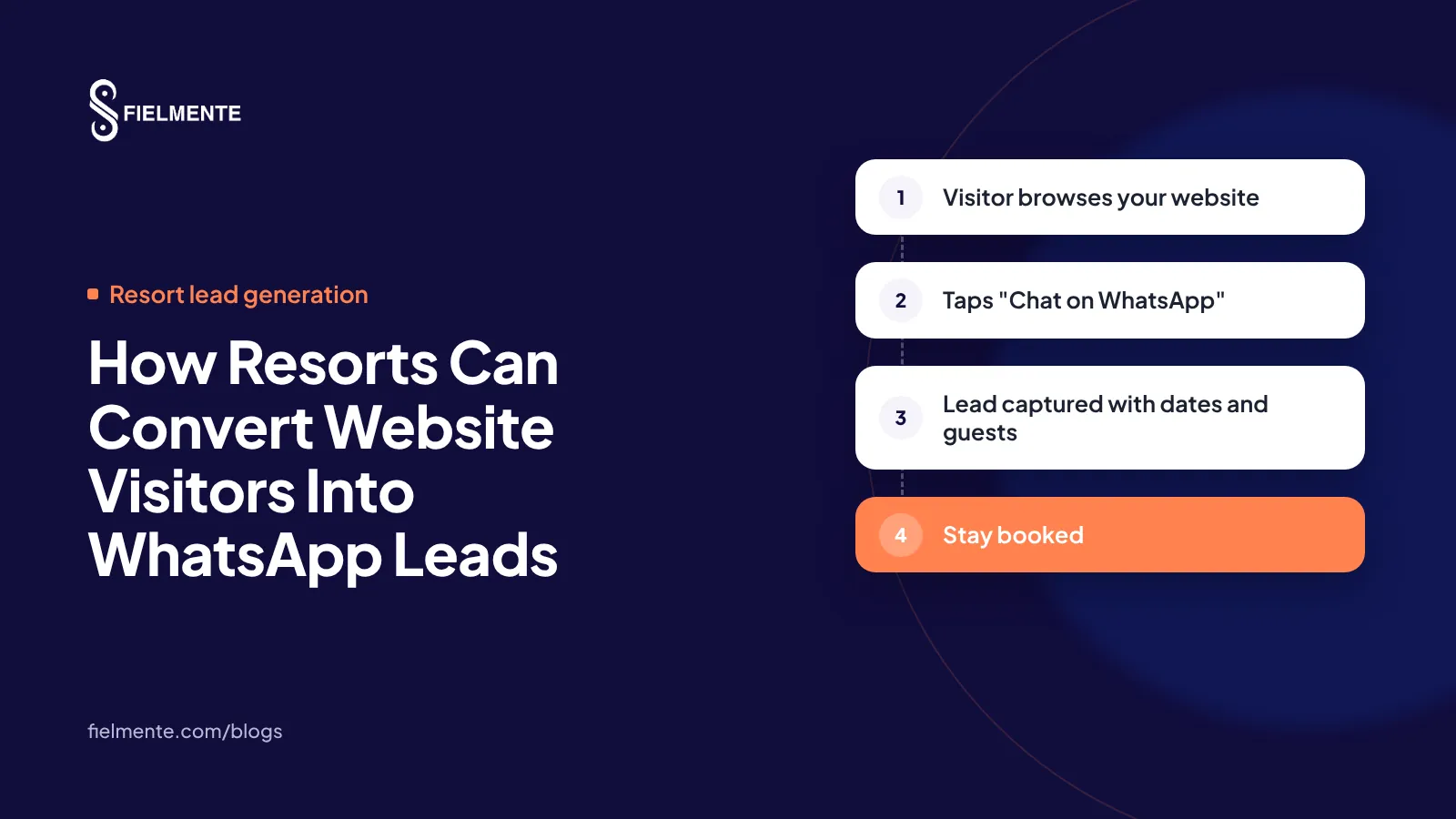
How the website-to-WhatsApp workflow works
- Visitor lands on the website: The visitor arrives through Google, social media, advertising, a referral or a direct visit.
- Visitor shows intent: The visitor views a room, package, offer, wedding, event or booking page.
- WhatsApp CTA appears: A contextual WhatsApp button gives the visitor an easy way to ask questions.
- Conversation starts: The WhatsApp message contains relevant page or product context.
- Automation qualifies the lead: The system asks only the information required to understand the enquiry.
- Information is verified: Availability, pricing and package details should come from approved hotel systems or be verified by staff.
- Lead receives the next step: The system can provide a booking link, request more information, schedule a call or transfer the conversation to sales.
- CRM records the lead: The enquiry, source, page context and sales status can be stored for follow-up and reporting.
What information should the WhatsApp agent collect?
The goal is not to create another long form inside WhatsApp. Collect only the information required to move the enquiry forward.
- Check-in date
- Check-out date
- Number of guests
- Number of rooms
- Room preference
- Package preference
- Purpose of stay
- Wedding or event date where relevant
- Approximate guest count for events
- Special requirements
Where AI and automation can help
A WhatsApp automation system can handle repetitive parts of the visitor journey without replacing the resort's sales team.
- Instantly acknowledge new enquiries.
- Identify the visitor's intent.
- Ask qualification questions.
- Answer approved FAQs.
- Share room or package information.
- Provide relevant booking links.
- Send brochures or approved marketing material.
- Schedule follow-ups for undecided leads.
- Route wedding enquiries to the events team.
- Route high-value enquiries to a human salesperson.
Keep humans in the loop
Not every enquiry should be handled entirely by automation. Resorts frequently receive complex requests where judgement and relationship-building are important.
- Large group bookings
- Wedding and event negotiations
- Corporate bookings
- VIP or high-value guests
- Complaints and sensitive issues
- Custom packages
- Special pricing requests
When the system transfers a conversation to a human, it should also transfer the relevant context so the guest does not have to repeat the entire conversation.
Important integrations
A useful resort WhatsApp system should connect with the systems that contain the information required to answer guests accurately.
- Website: captures visitor intent and page context.
- WhatsApp Business Platform: manages the messaging channel.
- CRM: stores leads, ownership and follow-up status.
- Booking engine: provides the appropriate booking path.
- PMS: can provide relevant operational information where supported.
- Payment system: supports the appropriate payment journey.
- Knowledge base: provides approved resort information for automated responses.
The exact architecture depends on the resort's existing technology stack. The important principle is that automation should not invent rates, availability, policies or package inclusions.
Track the complete conversion funnel
Simply counting WhatsApp conversations does not tell a resort whether the strategy is working. The important measurement is the journey from website visitor to revenue.
- Website visitors
- WhatsApp CTA clicks
- WhatsApp conversations started
- Qualified leads
- Sales hand-offs
- Booking links sent
- Confirmed bookings
- Direct-booking revenue
- Recovered or assisted revenue
Metrics that should be tracked
- WhatsApp click-through rate: measures how often visitors start a WhatsApp conversation.
- Lead qualification rate: measures how many conversations become useful sales opportunities.
- Enquiry-to-booking conversion: measures how many qualified conversations result in bookings.
- Direct-booking revenue: measures revenue generated or influenced by the channel.
- Human hand-off rate: shows how often automation requires sales involvement.
- Response time: measures how quickly enquiries receive assistance.
- Follow-up conversion: measures revenue generated from leads that did not book immediately.
Common mistakes to avoid
- Using the same WhatsApp CTA everywhere. Match the CTA to the visitor's page and intent.
- Asking too many questions. Qualification should be short and purposeful.
- Providing unverified availability. Automated systems should use approved live data or route the enquiry to staff.
- Sending every lead to the same salesperson. Route enquiries according to type, property, department or value where appropriate.
- Ignoring follow-up. A WhatsApp lead that does not book immediately may still have strong purchase intent.
- Measuring messages instead of revenue. The objective is qualified enquiries and bookings, not simply more conversations.
Frequently asked questions
How can resorts convert website visitors into WhatsApp leads?
Resorts can add contextual WhatsApp CTAs to high-intent pages such as rooms, packages, offers, weddings and booking pages. The CTA can open a conversation with a relevant pre-filled message, making it easier for the visitor to ask a question and become a qualified lead.
Where should a resort place WhatsApp buttons?
High-intent locations include room pages, package pages, wedding and event pages, special-offer pages and booking flows. The CTA should match the visitor's intent rather than using the same generic message everywhere.
Can AI qualify resort leads on WhatsApp?
Yes. AI can ask predefined qualification questions, identify enquiry type, collect dates and guest requirements, answer approved FAQs and route qualified conversations to the appropriate sales team.
Can WhatsApp leads be connected to a CRM?
Yes. A suitable integration can store the lead's contact details, source, page context, enquiry type, conversation status, owner and follow-up information in the resort's CRM or lead-management system.
How should resorts measure WhatsApp lead generation?
Track WhatsApp CTA clicks, conversations started, qualified leads, human hand-offs, booking conversions, direct-booking revenue and follow-up conversions. Comparing these numbers with the website's overall traffic helps identify the actual contribution of WhatsApp.
Final takeaway
Converting website visitors into WhatsApp leads is not about adding another chat button to a resort website. The real opportunity is to connect high-intent website behaviour with a structured sales process.
Start with the pages that generate the strongest booking intent, create contextual WhatsApp CTAs, capture only the information needed to qualify the enquiry, connect leads to the right sales workflow and measure the journey through to revenue.
For Fielmente, this approach fits into a broader hospitality strategy: helping resorts turn digital traffic into measurable conversations, qualified leads and direct bookings.
Work with Fielmente
Want to turn more resort website visitors into qualified WhatsApp enquiries and direct bookings? Talk to Fielmente about a hospitality-specific WhatsApp automation and lead-conversion strategy.
Not sure which platform fits your property? Get a free 15-minute website audit from our team.